

£28.16
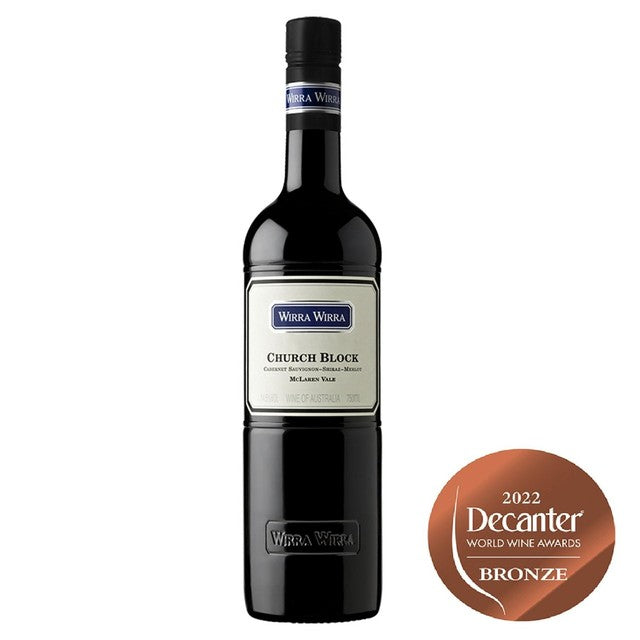
Enjoy the rich fruit flavours and smooth finish of Wirra Wirra Church Block, a premium Australian red wine blend. Perfect for dinners or special occasions, this wine hails from the renowned McLaren Vale region.
- Blend of 51% Cabernet Sauvignon, 42% Shiraz, and 7% Merlot for a balanced and complex profile.
- Produced by Wirra Wirra, a family-owned winery with history dating back to 1894.
- Features tasting notes of fresh red and dark fruits with grainy tannins and cedary oak.
- Alcohol content is 14.50% ABV, with 10.9 units per 75cl bottle.
- Suitable for vegetarians and vegans, with allergen information for eggs and sulphur dioxide.
- £28.16
- £28.16
- Unit price
- per
Shopped From |
M&S
Duties & Customs (You Pay)
Import fees may apply on arrival, and you must pay any customs charges. Prices exclude duties. Learn More: Shipping Policy | Terms and Conditions


Description
xChurch Block was the first wine the late Greg Trott produced under the Wirra Wirra label back in 1972. He took the name from one of the original vineyards, which runs next to the small Bethany Church (est.1854) across the road from Wirra Wirra's century old ironstone cellars. Over four decades, the Church Block label has become an Australian favourite.
Country of origin: Australia. Package type: Glass Bottle. Recycling information: Glass.
Other Information: Wines completed their secondary malolactic fermentation in tank or barrel, with oak selection and maturation times tailored to each wine and grape varietal - parcels showing a more powerful structure receiving a longer maturation time in oak before blending.
Allergen Information: Contains Eggs, Contains Sulphur Dioxide/Sulphites. Brand: Wirra Wirra. Manufacturer: 255 Strout Rd MCLAREN VALE 5171 Australia.
History: Wirra Wirra is a family-owned winery established in 1894 in the heart of McLaren Vale, South Australia. All red wines are sourced exclusively from the coastal region with a focus on the heritage varieties of Cabernet Sauvignon, Shiraz and Grenache.
Grape variety: 51% Cabernet Sauvignon 42% Shiraz 7% Merlot. Current vintage: 2022. Regional information: Wirra Wirra sources fruit from a selection of grower vineyards across McLaren Vale, including our own blocks adjacent to the winery.
Tasting notes: Fresh red and dark fruits provide great flesh and depth to a long, even palate. Grainy tannins and cedary oak add structural support and line to the rich fruit.
Alcohol by volume: 14.50% ABV. Units: 10.9. Producer: Wirra Wirra. Winemaker: Paul Smith.
Vinification details: Fruit was gently crushed and destemmed en route to fermenter. Early temperatures were maintained at 20-22ºC, rising to 25-28ºC at peak of ferment. In general, ferments were pumped over two to four times daily to assist flavour and colour extraction, as well as spreading heat through the cap and body of the ferment. Nearing completion and having achieved the desired flavour and tannin extraction, pump-overs were reduced to once or twice daily to keep the cap moist. Close to dryness, wine was drained from the fermenter and the remaining skins were pressed via tank or basket press. Wines completed their secondary malolactic fermentation in tank or barrel, with oak selection and maturation times tailored to each wine and grape varietal - parcels showing a more powerful structure receiving a longer maturation time in oak before blending.
